The
Mayor of London's Clearing House service, operated for the Mayor by
St Mungo's, has taken us to the brink of two small claims court actions under the Data Protection Act 1998 in the last two months. In the last two years we have brought
four court actions to court orders just to keep a roof over our heads, including three against the Greater London Authority (GLA). The next time Declan has to file a case in some court or other, our latest dispute with GLA Clearing House over its handling of our personal information - which was only resolved yesterday - will be dealt with as in (iii) below.
For our next court action
... To pick out three particular historical examples fuelling this belief [re St Mungo's] that involve a High Court action and the threat of two small claims court actions:
(i) During the second period the Claimant and his wife spent on the street between April 2013 and May 2014, St Mungo's (then called Broadway) denied them support to access the private rented sector despite the fact that they had the funds to do so. On 29 August 2013, the Claimant filed a claim in the High Court for judicial review against Commissioner of Police for the City of London Adrian Leppard and Home Secretary Theresa May, arguing that it was unreasonable for the Police Force to refuse to ask the charity to help them break an alleged accommodation blockade whilst at the same time threatening them with hosings by street cleaners. Deputy High Court Judge Bidder ruled: "The refusal of the First Defendant to ask the charity 'Broadway' to engage or help the Claimant and his wife with their welfare or accommodation is not arguably unreasonable. It is not its job to intervene in any disagreement between a charity and those seeking that charity's help."
(ii) On 8 May 2015 District Judge Brooks sitting at the County Court at Central London declared that the Single Homeless Project had "acted unlawfully in holding or uploading information about the Claimant relating to his debts, his employment status and an alleged mental health condition", and ordered the charity to pay damages to him for distress of £750. However, three months later, following a subject access request, the Claimant discovered that St Mungo's had failed to comply with the court order which also requested that it remove from its website any information about him and his wife "in relation to debts that they have, their employment status and to specifically remove the word 'grandiose'." It took St Mungo's a further six months, and the threat on 11 February 2016 of an immediate small claims court action, to finally remove all inaccurate financial and other information held against the Claimant and his wife on the Clearing House system.
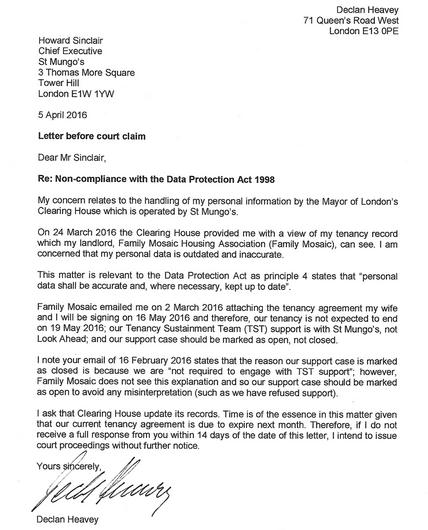
(iii) On 5 April 2016 the Claimant issued St Mungo's CEO Howard Sinclair a Letter Before Claim in respect of the handling of his and his wife's personal information on the Clearing House system. The Claimant challenged as misleading Clearing House's decision to mark their Tenancy Sustainment Team (TST) support as closed when Housing First ceased on 31 March 2015 because "an exception was made for you in that you were not required to engage with TST", according to Mr Sinclair in an email dated 16 February 2016. The GLA had repeatedly falsely accused the Claimant and his wife in court papers of refusing support, something it could not have done had their support status been marked as 'open'. It took St Mungo's a further two weeks, and the threat of an immediate small claims court action, to finally change the Claimant and his wife's status to 'open' on 18 April 2016.
Heavey v St Mungo's
Background
3. The Claimant is a former teacher and his wife a former psychologist. They have no children. They are employees of the London-based Network for Church Monitoring (N4CM), the Claimant as the company's Managing Director and his wife as Webmaster of N4CM's website called "Church and State". Edd Doer, President of Americans for Religious Liberty: "Let me recommend an important website churchandstate.org.uk. Operating out of London this well designed and exciting website covers church-state, population, climate change and other issues. Check it out."
4. The Claimant and his wife have been forced to sleep rough on the streets of London for almost 4 years in total – from 4 November 2006 to 13 July 2009, and again from 14 April 2013 to 17 May 2014. Before coming off the street the second time, the Mayor of London's Clearing House service, operated for the Mayor by St Mungo's, matched them to a property owned by Family Mosaic Housing Association. They moved into this property on 17 May 2014 as clients of the Greater London Authority ("GLA") Housing First project, with support being provided by the Single Homeless Project ("SHP"), one of three charitable organisations funded by the GLA to operate the Housing First service within the Greater London Authority area.
5. Housing First is an internationally acclaimed programme for people with a history of rough sleeping, the core principles of which are the provision of permanent accommodation and non-compulsory support (Johnsen with Teixeira, 2010). These principles are reflected in the funding agreement of 13 March 2014 between the GLA and SHP, which provides that "Clients who meet the criteria for a Housing First offer will be offered long term tenancies…. Long term tenancies would mean for a minimum of two years with the possibility to extend and preferably for the lifetime of the client ... Whilst the client is under no obligation to engage with other support services the Housing First worker will work with the client to give them information on services that the client could access."
6. On 4 September 2014, less than four months into the Claimant and his wife's tenancy, the Claimant received an email from SHP informing him for the first time that GLA Housing First was a pilot project which would come to an end on 31 March 2015, stating that "Clearing House has asked that clients who want to remain in their accommodation and who are managing their tenancies well, are referred back to the clearing house for them to assess. They will then assess these clients to ensure they feel they are able to manage the tenancy with TST support."
7. GLA Clearing House departs significantly from the key principles of the Housing First model, in that it does not provide the permanent accommodation and voluntary support characteristic of Housing First. It requires clients to engage with the GLA's commissioned Tenancy Sustainment Team ("TST"), formally provided by Look Ahead and now provided by St Mungo's; clients are expected to comply with holistic support plans; and "eligibility for flats, issued on two-year renewable Assured Shorthold Tenancies, terminates when individuals are deemed to no longer require support to live independently" (Johnsen and Teixeira, 2012).
8. The Claimant wrote on numerous occasions to SHP and provided the GLA with two pre-action protocol letters protesting his and his wife's referral to GLA Clearing House, but to no avail. Finally, on 18 June 2015, the Claimant filed at the High Court an application for permission to apply for a judicial review against the GLA. The GLA in its Grounds of Opposition to the Claimant's claim for judicial review stated: "At the end of the Housing First pilot, the tenants would revert to being standard Clearing House tenants and as such would fall to be referred to the TST like all other Clearing House tenants…. The GLA, acting reasonably and within its statutory powers, was entitled to choose Clearing House as a replacement for the Housing First pilot."
9. By order dated 12 August 2015, High Court Judge Lavender refused the Claimant permission to bring judicial review proceedings on the grounds that his claim form should have been filed within three months after the grounds to make the claim arose with SHP's email of 4 September 2014, and that the GLA had not committed a violation of the applicable law by referring him and his wife from GLA Housing First to GLA Clearing House, thereby terminating their eligibility for their flat within one year of the commencement of their tenancy because they are able to live independently.
10. On 10 September 2015 the Claimant filed a claim for damages in the Central London County Court against the GLA for depriving him of a review of its decision to refer him and his wife to GLA Clearing House. He cited Connors v UK (2004) in saying that the legal framework applying to the referral decision that had deprived him of a review had not provided him and his wife with sufficient procedural protection of their rights.
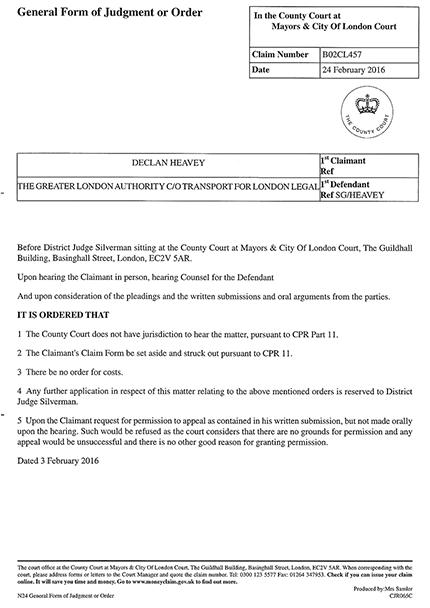
11. At a jurisdictional hearing on 3 February 2016, District Judge Silverman ruled that "The County Court does not have jurisdiction to hear the matter pursuant to CPR Part 11". He rebuked counsel acting for the GLA for saying that the Claimant had refused support, clarifying that there is a distinction to be made between refusing support and not accepting coercive support. He also spoke in his judgment of the "home" the Claimant and his wife have made for themselves with their own money, how impressed he was with the Claimant's behaviour in court, and the commitment he had received in court from the said counsel to arrange round-table talks to try to come to some agreement.